Crucial is the consumer storage brand of Micron, one of the largest memory makers in the world, which gives it a lot of name recognition on store shelves. KingSpec's current lineup matches Crucial's specs closely tier for tier, and even beats Crucial outright on the fastest PCIe 5.0 drive, while KingSpec's listed prices run lower than Crucial's current retail prices at comparable capacities. Crucial still holds an edge on warranty length across most of its range. Here is a full, model by model breakdown sourced directly from both brands.
KingSpec vs Crucial SSD, Quick Comparison
| Category | KingSpec | Crucial | Likely winner |
|---|---|---|---|
| SATA | P3 up to 8TB, 580/570MB/s, from $29.99 | BX500 up to 4TB, 540/500MB/s | KingSpec |
| Budget NVMe | NE series PCIe 3.0, up to 3,200/2,000MB/s | P3 Plus PCIe 4.0, up to 5,000/4,200MB/s | Crucial |
| Flagship NVMe | XG7000 PCIe 4.0, 7,400/6,600MB/s, up to 8TB | T500 PCIe 4.0, up to 7,400/7,000MB/s, up to 4TB | Near tie |
| PCIe 5.0 NVMe | X500 up to 14,000/13,000MB/s | T700 up to 12,400/11,800MB/s | KingSpec |
| Portable SSD | Z5, 2,100/1,850MB/s, USB 3.2 Gen2x2 | X10 Pro, 2,100/2,000MB/s, USB 3.2 Gen2x2 | Near tie |
| Warranty length | 3 years across the current lineup | 3 years on BX500, 5 years on P3 Plus, T500, T700, and X10 Pro | Crucial |
| Price at comparable capacities | Clearly listed, generally the lower option | Runs higher at current retail prices | KingSpec |
Storage prices have climbed sharply across the industry through 2026, and Crucial's current retail prices reflect that. KingSpec's listed prices are lower at every comparable capacity checked for this article. Always check current pricing before buying, since both brands' prices can move quickly.
SATA SSDs: KingSpec P3 vs Crucial BX500

SATA speed is capped by the interface itself, so a budget SATA drive and a well known one tend to land close together on paper. The BX500 is Crucial's long running entry level SATA drive, and the P3 is KingSpec's equivalent.
KingSpec P3
Crucial BX500
Crucial rates the BX500 at up to 540MB/s read and 500MB/s write, with capacities running up to 4TB, the same ceiling as the P3. KingSpec's P3 reads and writes a little faster on paper. Both carry a 3 year warranty and both use a DRAM-less controller design to keep costs down. On price, KingSpec has the edge, current retail prices for the BX500 run higher than KingSpec's direct pricing at comparable capacities.
Budget NVMe: KingSpec NE Series vs Crucial P3 Plus
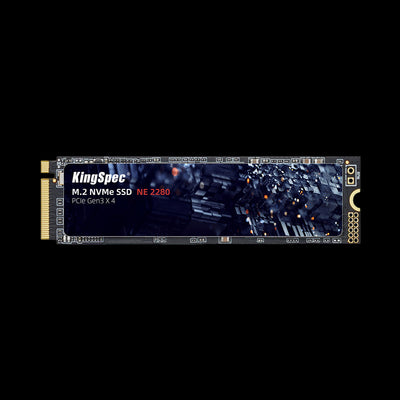
This is the one category where Crucial's spec sheet shows a clear generational edge. The P3 Plus runs on a PCIe 4.0 controller, while KingSpec's NE series is built on PCIe 3.0.
| Model | Interface | Read/Write | Max capacity | Warranty |
|---|---|---|---|---|
| KingSpec NE series | PCIe 3.0 x4 | 3,200/2,000 MB/s | 2TB | 3 Years |
| Crucial P3 Plus | PCIe 4.0 x4 | Up to 5,000/4,200 MB/s | 4TB | 5 Years |
Crucial's P3 Plus is built with Micron Advanced 3D NAND and reaches up to 5,000MB/s read and 4,200MB/s write at its higher capacities, backed by a 5 year warranty. KingSpec's NE series is the more affordable, lower spec option built for a straightforward SATA to NVMe upgrade rather than for chasing PCIe 4.0 bandwidth. If raw NVMe speed at this price tier matters most to you, the P3 Plus has the edge on paper, though it also costs noticeably more, current retail prices for the P3 Plus run well above KingSpec's NE series, which starts at $45.99.
Flagship NVMe: KingSpec XG7000 and X500 vs Crucial T500 and T700
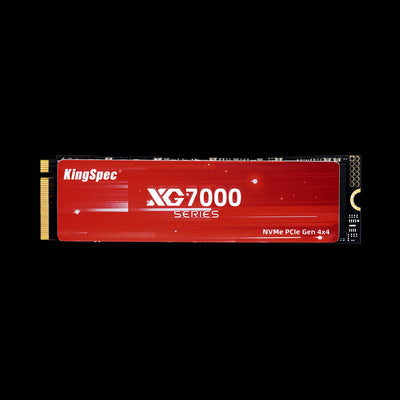
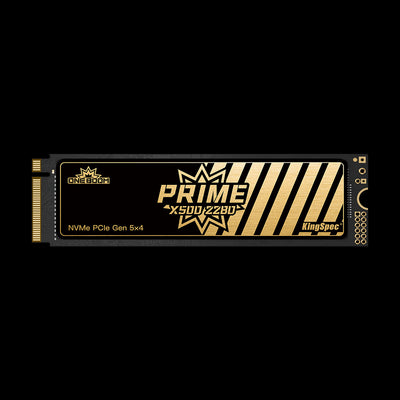
Crucial actually fields two tiers here worth comparing. The T500 is Crucial's PCIe 4.0 flagship, the direct match for KingSpec's XG7000, and the T700 is Crucial's PCIe 5.0 flagship, which lines up against KingSpec's X500. The X500 edges out the T700 on paper speed.
| Model | Interface | Read/Write | Max capacity | Price |
|---|---|---|---|---|
| KingSpec XG7000 | PCIe 4.0 x4 | 7,400/6,600 MB/s | 8TB | $113.99 (512GB) |
| Crucial T500 | PCIe 4.0 x4 | Up to 7,400/7,000 MB/s | 4TB | Runs higher, often $200+ at 1TB |
| Crucial T700 | PCIe 5.0 x4 | Up to 12,400/11,800 MB/s | 4TB | Runs higher, often $400+ at 2TB |
| KingSpec X500 | PCIe 5.0 x4 | 14,000/13,000 MB/s | 4TB | $204.99 (1TB) |
Crucial's T500 uses TLC NAND that Crucial describes as the first 232-layer TLC NAND design, backed by a 5 year warranty and TBW ratings from 300TB at 500GB up to 2,400TB at 4TB. Its top sequential speed of 7,400MB/s read is essentially tied with the XG7000, though the XG7000 goes up to 8TB, double the T500's 4TB ceiling, on a 3 year warranty instead of 5. Crucial's T700 steps up to PCIe 5.0 with a Phison E26 controller and the same TLC NAND generation, backed by a 5 year warranty and TBW ratings from 600TB at 1TB up to 2,400TB at 4TB. KingSpec's X500 is rated faster on both read and write than the T700. On price, KingSpec wins across the board, current retail prices for a 1TB T500 have been running $200 or more and a 2TB T700 well above $400, while KingSpec's XG7000 starts at $113.99 and the X500 starts at $204.99.
Portable SSDs: KingSpec Z5 vs Crucial X10 Pro
Both brands make a pocketable USB-C drive built around USB 3.2 Gen 2x2 speeds, and the specs land within a hair of each other.
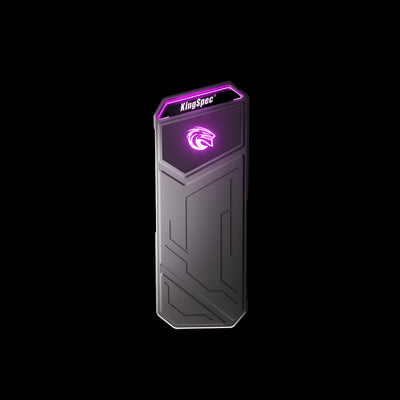
KingSpec Z5
Crucial X10 Pro
Crucial's X10 Pro carries an IP55 rating for water and dust resistance, drop protection up to 7.5 feet, 256-bit AES hardware encryption with password protection, and a 5 year warranty. KingSpec's Z5 writes a little faster and adds an RGB light strip, with a 3 year warranty. KingSpec has not published an IP rating or hardware encryption for the Z5, so treat the X10 Pro's security and durability features as its clearest edge. On price, KingSpec wins again, current retail prices for a 1TB X10 Pro have been running well above $150, while the Z5 starts at $85.99 for 512GB.
Gaming Storage: Capacity Usually Beats Benchmarks
Modern game installs routinely run 80 to 150GB each, so the amount of usable space per dollar tends to matter more than a small gap in sequential speed.
- KingSpec's XG7000 and X500 offer 8TB and 4TB maximum capacities, both ahead of the T500's and T700's 4TB ceilings
- KingSpec's X500 reads and writes faster than Crucial's T700 according to each brand's own published numbers, while the XG7000 and T500 are essentially tied on read speed
- The Z5 and X10 Pro are both fast enough to run some games directly over USB-C from a laptop or handheld
- Crucial's P3 Plus is a reasonable step up from SATA for PCIe 4.0 gaming builds on a tighter budget
Everyday Computing: Both Brands Are Fast Enough

Boot times, app launches, and browsing do not come close to saturating even a budget SATA SSD, let alone a PCIe 4.0 or 5.0 drive. For office work, schoolwork, and general home use, a well reviewed KingSpec drive and a comparable Crucial drive will feel effectively identical. The differences that matter most in this category are price and warranty length.
NAND, Endurance, and TBW
Both brands publish TBW (terabytes written) figures for every drive. KingSpec's SATA and NVMe drives use 3D NAND across the lineup, with TBW scaling from 30TB on the smallest P3 capacity up to 4,000TB on the 8TB XG7000. Crucial rates the BX500 at 80 to 1,000TB across its capacity range, the T500 at 300 to 2,400TB, and the T700 at 600 to 2,400TB depending on capacity. For typical home and office use, writing 20 to 50GB per day, either brand's TBW rating will comfortably outlast the useful life of the computer it is installed in.
Software and Support
Crucial includes its Storage Executive software with its drives, used for firmware updates, drive health monitoring, and secure erase, plus a bundled copy of Acronis backup software on several models. KingSpec's support resources vary by model and region and lean more on documentation and email support than a dedicated management app. Crucial also backs the P3 Plus, T500, T700, and X10 Pro with a 5 year warranty, two years longer than KingSpec's 3 year coverage, though Crucial's own BX500 only carries a 3 year warranty to match KingSpec. If you value a longer warranty window and bundled software on NVMe and portable drives, that is where Crucial has the clearest advantage.
Compatibility Checklist Before You Buy
- Confirm SATA or NVMe support on your motherboard or laptop
- Check the PCIe generation your M.2 slot actually supports
- Match the M.2 length, most desktops and laptops use 2280
- Check clearance if the drive ships with a heatsink
- Confirm the maximum capacity your system or BIOS supports
- Compare current prices for both brands before buying, since storage prices have been moving quickly through 2026
- Check the seller's return policy on both KingSpec and Crucial listings
Verdict: KingSpec Wins on Capacity and Price, Crucial Wins on Warranty
For SATA, flagship NVMe, and PCIe 5.0 storage, KingSpec offers higher maximum capacities, competitive or faster speeds, and lower prices than Crucial's current retail pricing at comparable tiers. Crucial's P3 Plus has a real speed edge in the budget NVMe tier, and Crucial backs the P3 Plus, T500, T700, and X10 Pro with a longer 5 year warranty plus its Storage Executive software. If you want the most storage and speed for your money at a lower price, KingSpec is the easier recommendation. If a longer warranty and bundled software matter more to you than price, Crucial is a reasonable choice too.
KingSpec vs Crucial SSD, FAQ
Is KingSpec as reliable as Crucial?
Is KingSpec faster than Crucial?
Is Crucial more expensive than KingSpec?
Which is better for gaming, KingSpec or Crucial?
Does KingSpec work with the same systems as Crucial?
Shop KingSpec SSDs
Get more capacity and speed without paying Crucial's current retail prices.